
Name Change Process in Punjab: Willing to change your name in the documents in Punjab? It requires you to go through strict adherence to government protocols.
No matter if you want to alter your name due to marriage, divorce, spelling errors, astrological reasons, or gender transformation, it must be officially registered to become legally valid.
Name Change Process in Punjab
In the state of Punjab, residents have two different legal methods through which they can formalise a name change.
These two are;
- Punjab Gazette name change online
- Central Government Gazette of India.
Indeed, both the procedures mandates legally binding publication. But, their administrative systems, document submission offices, and long-term usage differ. Certainly, the name change through state limits the validity of the documentation on the state level only.
Getting the name change through centralized gazette notification is a better option as it validates your document throughout India and even abroad.
Moreover, if you want to get the central gazette at some point of time, after getting the state one, it will be difficult to manage.
Since centralized gazette requires documents with old name, and when the name has already been changed at the state level, your old name would no longer exist.
This may create an issue in getting centralized gazette notification done. So, it is always better to get the gazette notification through central Government.
e Gazette Punjab- Necessary for Name Change?
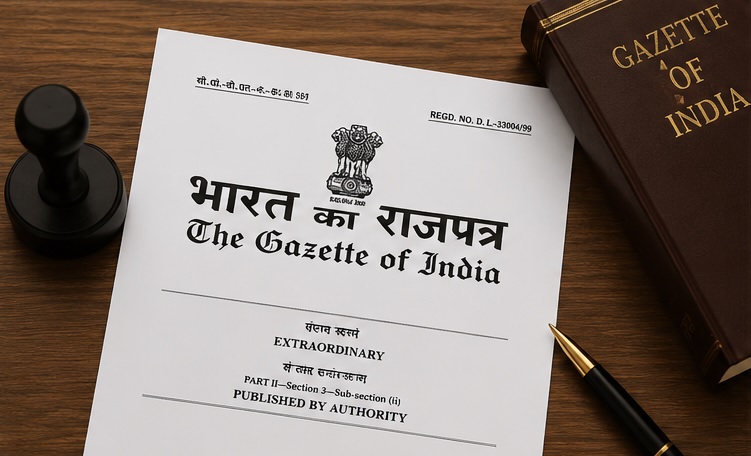
Gazette Notification is one of the most important and legal way to change your name on centralized basis. It acts as a perfect option to legalize your name change, prevent any kind of fraud, and essential for updating citizen-based records.
Legal and Practical Reasons for e Gazette in Punjab
- Authorized Government Recognition: The gazette notification validates the name change by government and certifies that the new name is legally binding.
- Mandatory for ID Updates: Many authorities necessitate the Gazette certificate to change names on major documents such as passport, Aadhaar Card, PAN card, and bank accounts.
- Fraud Prevention: Publicly publishing the name change ensures transparency and stops people from using multiple identities to commit any kind of fraudulent practices.
- Government Jobs: It is mandatory for the public sector and government employees to submit a Gazette notification for officially altering their service records.
Name change in Punjab Process
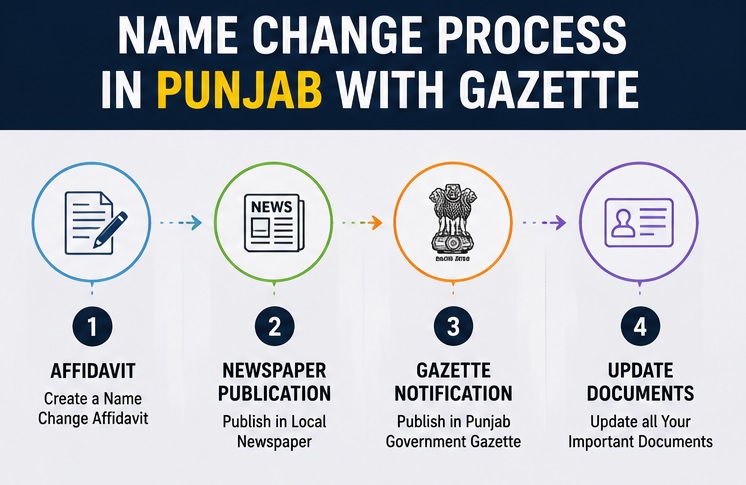
Before applying to either the State or Central Gazette departments for name change in Punjab, it is necessary to execute certain mandatory legal steps. The purpose of doing so is to highlight your intent to change your name and create its public record.
1. Drafting Name Change Affidavit
The first step is to create an affidavit that declares the reason for your name change. You have to print the text on a non-judicial stamp paper. It must explicitly state your old name, husband’s or father’s name, residential address in Punjab, and your new name.
After preparing the affidavit from a certified lawyer, you should get it signed and stamped by a Notary Public or an Executive Magistrate in Punjab.
Notary attestation in case of changing First name or adopting surname of your father or husband, 1st Class Magistrate in case of adopting Surname other than Father or Husband.
2. Newspaper Advertisement
It is mandatory to announce your name change to the general public by publishing notifications in a local newspaper circulating in your district of Punjab.
The advertisement should contain your old name, residential address, and the new name. This informs the public that the old name will no longer be active for communication.
3. Gazette Notification File
When it comes to sending documents to the Publication Department, you should prepare a Gazette file. The file should contain;
- The duly-filed affidavit attested by a notary or First-class magistrate
- Original newspaper page bearing the advertisement
- Two self-attested photocopies of your ID proof having the old name, and Aadhar Card copies of the two witnesses.
- Compact Disc (CD), having the same information mentioned in your affidavit.
- CD certificate, confirming the authenticity of the matter in CD and Affidavit.
4. Govt. Fee Payment
The processing fee for the Central Gazette Notification ranges between Rs.1,100 for adults to ₹1,700 for minor gazette name change.
The fee can be paid digitally through the Bharatkosh Portal or at the Fee counter if you are going in person to submit your file.
Then, you can download the receipt and attach the same with other documents in the file.
Submission and Publication
There are two modes of submission;
In-Person Submission
It is always better to go in person to the office of the Publication Department in New Delhi to submit the file. If you visit the office personally, the notification is uploaded within 4 to 5 weeks.
Submission via Post or Courier
After paying the fee and completing the Gazette Notification file, you can send it through speed post or registered post to the Controller of Publications, Department of Publication in Delhi.
This option is available for people who are staying far from the New Delhi office.
The Gazette notifications are uploaded within 45 to 60 days for the working days for people sending the Gazette notification file through post.
After submitting the file, you have to check for your gazette name in the official portal of the Publication Department.
It is updated weekly around 10 am in the morning on every Saturday on their official website. So, you will have to keep a constant check on the website to check and get the printout if it appears in the list.
Gazette Notification enables you to provide details such as the old name. Once it is published on the portal, you have to take the gazette as proof of identity for including your surname in Aadhaar or any other document.
Certainly, it is important for people to go through such a legalised process for changing their name.
This gazette notification from the Central Government provides widespread, pan-India validity for the people of every Indian state, including Punjab. It is recognised by the Ministry of External Affairs, different immigration authorities, Central Universities, and the global financial bodies.